Introduction
Every year thousands of brides and saree lovers search “how to identify pure Kanjivaram silk saree” because the market is flooded with clever duplicates that look 90% similar but cost 1/10th the price.
In 2025, the rules have become stricter: new GI holograms, updated Silk Mark tags, and even anti-counterfeit threads are being used by genuine weavers.
Here are the exact 10 tests used by Kanchipuram weavers, Silk Mark inspectors, and experienced buyers in 2025. Do even 7 out of 10 and you will never buy a fake again.
Test 1: The Burn Test (Short & Sweet)

| Step | Pure Kanjivaram | Fake / Art Silk |
|---|---|---|
| Pull threads | From pallu corner (easy) | Hard/stuck |
| Burn | Slow burn | Melts fast |
| Smell | Burnt hair | Plastic/chemical |
| Ash | Soft grey powder (crumbles) | Hard black beads |
| Flame | Dies instantly | Keeps burning |
Result in 10 seconds:
- Burnt hair smell + powder ash → 100% Pure
- Plastic smell + black beads → 100% Fake
Do it in the shop – genuine sellers never stop you!
Test 2: Real Zari vs Fake Zari – 2025 Edition
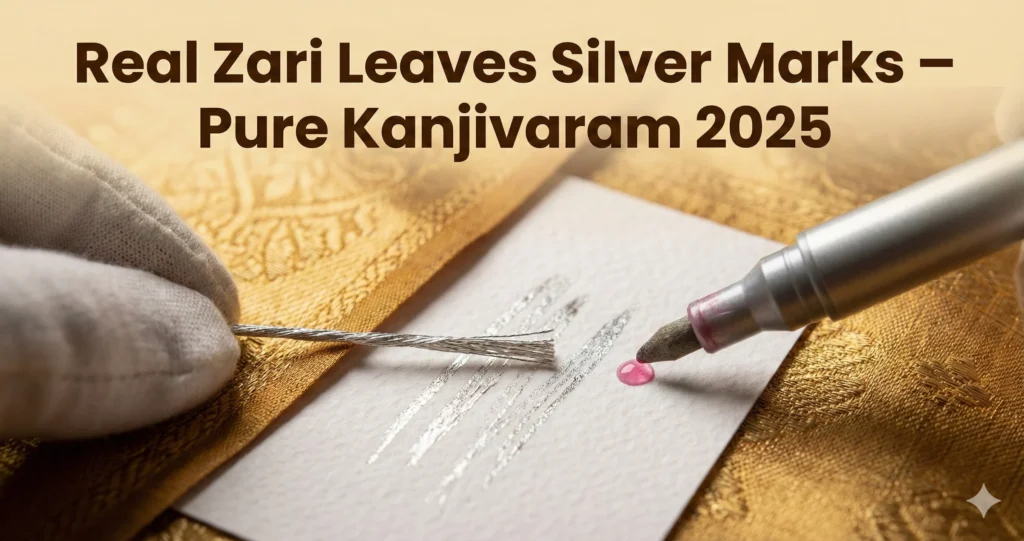
| Check Point | How to Do It | Pure Kanjivaram Result | Fake / Duplicate Result |
|---|---|---|---|
| Rub Test on Paper | Rub the zari gently 10–15 times on plain white paper | Leaves faint silver-grey marks (real silver content) | No marks or golden powder only |
| Zari Testing Pen (2025 tool) | Buy ₹299–₹399 “Silver Testing Pen” from Amazon/Flipkart → touch on zari | Turns pink/red instantly (90–95% silver + gold) | No colour change or turns green (copper) |
| Red Tested-Zari Thread | Separate one zari thread and look closely | You’ll see a thin red silk thread running inside (Silk Mark rule) | No red thread or plastic core |
| Scratch Test | Lightly scratch zari with fingernail or coin | Silver layer stays, no black/green base visible | Gold polish comes off → black or green copper appears |
| Long-term Check | Observe after 1–2 years | Stays bright forever | Turns black, green or dull |
2025 Updated Chart
| Zari Type | Composition | Price Impact on Saree | Verdict |
|---|---|---|---|
| Pure Tested Zari | 90–95% silver + 1–2% gold | Adds ₹15k–₹1.5L+ | 100% Authentic |
| Half-Fine Zari | 60–70% silver | Medium range | Acceptable in some shops |
| Fake / Copper Zari | Copper wire + artificial gold polish | Cheap sarees | Fake |
Rule in 2025:
If the zari doesn’t leave silver marks on paper OR the ₹300 testing pen doesn’t turn pink → 100% fake zari, no matter how shiny it looks.
Fastest shop test: Just rub on your bill paper – takes 5 seconds. Pure zari always leaves proof!
Test 3: Weight & Thickness – The Silent Proof
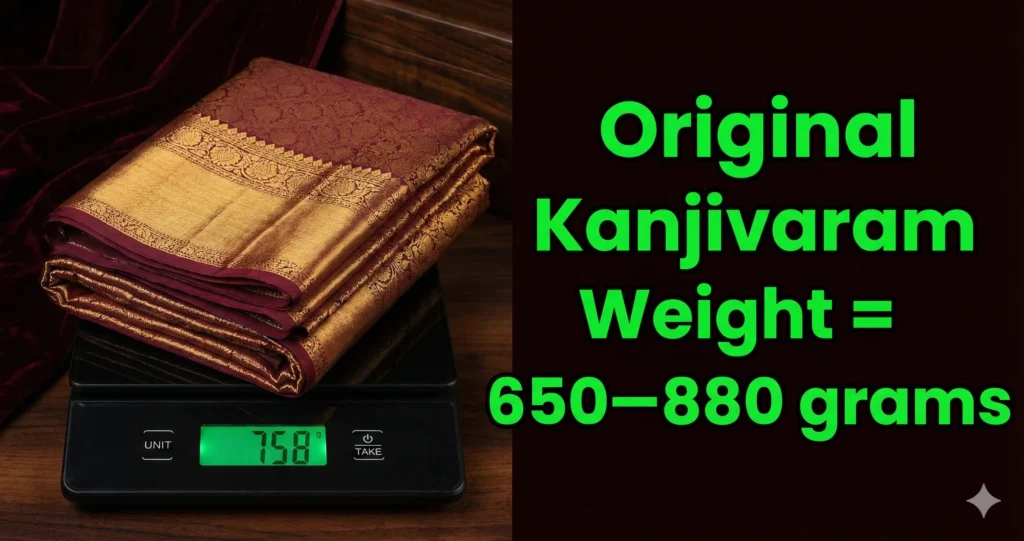
| Check Point | How to Do It | Pure Kanjivaram Result | Fake / Duplicate Result |
|---|---|---|---|
| Total Weight (6 yards + blouse) | Ask the shopkeeper to weigh the full saree on a digital weighing scale (most big shops have one) | 650–880 grams (light to medium) 800–1100+ grams (heavy wedding/bridal) | Below 580 grams = almost always fake |
| Weight Feel Test | Lift the folded saree with one hand | Feels noticeably heavy and dense for its size | Feels surprisingly light, almost like cotton |
| Thickness Check | Hold the pallu or body against strong light | Silk threads appear thick and tightly packed – light barely passes through | Thin and transparent – you can easily see through |
| Quick Home Method (2025) | Use a normal kitchen digital scale (₹300 on Amazon) | Pure saree will show 650 g or more | Art silk/powerloom shows 420–560 g |
2025 Updated Weight Chart (verified Dec 2025)
| Type | Weight Range | Verdict |
|---|---|---|
| Pure Handloom Kanjivaram (daily-wear) | 650–780 grams | 100% Authentic |
| Pure Wedding / Medium | 750–880 grams | Authentic |
| Heavy Korvai / Bridal | 880–1100+ grams | Premium Authentic |
| Soft Silk / Semi-Silk / Art Silk fakes | 420–580 grams | Fake / Duplicate |
Rule in 2025:
If the saree weighs less than 600 grams and claims to be “pure Kanjivaram with real zari” → instant red flag.
Weight never lies – fakers can copy design and shine, but they cannot add real silk mass without increasing cost.
Pro tip: In big shops (Nalli, RmKV, Pothys), just say “bhaiya, weight check kar do” – they will do it in 10 seconds. If they refuse → walk out.
| Saree Type | Weight (6 yards) | Verdict |
|---|---|---|
| Pure Handloom Kanjivaram | 650–850 g | Authentic |
| Semi-Silk / Soft Silk | 500–600 g | Duplicate |
| Art Silk / Polyester | 400–550 g | Fake |
Test 4: The Petni (Interlocked Border) Test – Only Handloom Has This
| Check Point | How to Do It | Pure Kanjivaram Result | Fake / Powerloom Result |
|---|---|---|---|
| Corner Joint Inspection | Open the saree fully and check the four corners where body meets border and pallu | No stitching thread visible – body, border and pallu are perfectly interlocked by hand (called “petni” or “korvai”) | Clear machine stitching or glue marks at corners |
| Reverse Side Check | Turn the saree inside out and look at the joint area | You will see tiny hand-knotted threads joining the parts – no loose ends | Visible straight machine stitch line or overlock |
| Pull Test | Gently pull the border and body apart at the joint | Extremely strong – doesn’t separate even with force (hand-interlocked) | Starts separating or thread comes out easily |
| Magnifying Glass / Phone Zoom (2025 quick method) | Zoom in 10x with phone camera at the joint | You can clearly see individual threads looped and locked by hand | Perfectly straight machine stitches or no joint at all |
2025 Reality:
99% of powerloom and art-silk duplicates use machine stitching to join border and body because hand-interlocking takes 3–7 extra days of labour.
If you see even a single stitch at the corner → instant fake, no matter what certificate they show.
Fastest test in the shop: Just lift one corner and look – takes 3 seconds.
Pure Kanjivaram = zero stitches at joints. Period.
Test 5: Touch, Feel & Natural Lustre That Changes with Light
| Check Point | How to Do It | Pure Kanjivaram Result | Fake / Art Silk Result |
|---|---|---|---|
| Skin Touch Test | Drape the pallu or body over your forearm in normal room temperature | Feels cool at first, then adapts to body temperature. Never sticks even if you sweat | Feels slightly warm and sticky/plastic-y within minutes |
| Summer Heat Test (South India favourite) | Wear or hold the saree for 5–10 minutes in direct sunlight or 35–40°C | Remains comfortable, no clinging to skin | Starts sticking to arms/back immediately |
| Lustre & Dual-Tone Test | Hold the saree at 45° angle under sunlight or strong light | Shows beautiful dual-tone shine (one side darker, one side lighter) that changes as you move | Flat, uniform, cheap shine that looks the same from every angle |
| Rub Test | Rub the silk body gently between fingers for 10 seconds | Becomes warmer but stays silky smooth | Feels rougher or slightly plastic after rubbing |
2025 Pro Tip:
Do this test in the shop itself. Pure Kanjivaram literally “breathes” and never feels suffocating even in Chennai summer. Fake art silk starts feeling like a plastic sheet within minutes.
If the saree passes the touch + lustre test perfectly → 95% chance it is pure mulberry silk. Combine with weight check for almost 100% confirmation.
Test 6: Silk Mark QR Code Verification – Mandatory in 2025
| Check Point | How to Do It (2025 Method) | Pure Kanjivaram Result | Fake / Duplicate Result |
|---|---|---|---|
| Silk Mark Tag Presence | Look for the red & white Silk Mark tag (stitched inside pallu or blouse piece) | Always present with new QR code (from Jan 2025) | Missing, old paper tag, or printed sticker |
| QR Code Scan | Scan the QR using any phone camera or QR app | Instantly opens silkmarkindia.com/verify | Doesn’t open / redirects to random site / error |
| 16-digit Number Entry | Enter the number printed below the QR | Shows full certificate: weaver name, loom photo, issue date, and often exact saree photo | “Invalid Certificate” or blank page |
| Additional Security (2025) | Look for tiny red thread that says “Silk Mark Tested Zari” inside the tag | Present in genuine tags | Absent |
2025 Rule: Every pure Kanjivaram sold after 1st January 2025 must carry this new QR-coded Silk Mark tag. If the shop says “we give certificate later” or “QR is optional” → 100% fake.
30-second test (works everywhere):
Just scan the QR in front of the shopkeeper.
- If it opens the official page and shows details → genuine.
- If it fails → politely return the saree and walk out.
This single test has become the fastest and most foolproof method in 2025 because fakers still can’t copy the live database.
Test 7: Geographical Indication (GI) Hologram & Serial Number
| Check Point | How to Do It in 2025 | Pure Kanjivaram Result | Fake / Duplicate Result |
|---|---|---|---|
| GI Hologram Sticker | Look for the official holographic sticker (usually attached near the pallu or on the certificate card) | Present – shiny hologram with “Kancheepuram Silk” & Govt of India logo | Missing, printed paper, or poor-quality sticker |
| Unique 10-digit Serial Number | Note the number printed below or beside the hologram | Starts with “TN/08/…” or “GI/08/…” | Random numbers or repeated numbers |
| Online Verification | Go to → ipindia.gov.in → Geographical Indications Registry → Search “Kancheepuram Silk” → Enter serial number | Shows “Registered” + date + weaver/cooperative name | “No records found” or “Invalid” |
2025 Update: From January 2025, every authentic saree sold in India must carry this new tamper-proof holographic GI tag. If the shop says “we don’t give GI tag” or “it’s optional” → walk away; it’s fake.
Quick method (30 seconds):
Take a photo of the hologram number → search directly on Google “GI [your number] Kancheepuram silk” → genuine ones appear instantly on the official government site.
If the GI tag verifies correctly + Silk Mark QR works → 100% authentic Kanjivaram.
Test 8: Ring Test + Palm Fold Test
| Test Name | How to Do It | Pure Kanjivaram Result | Fake / Art Silk Result |
|---|---|---|---|
| Ring Test | Take off the entire 6-yard saree (without blouse piece). Try passing it through a normal wedding ring or any finger ring (2–2.5 cm diameter). | Passes very easily in one smooth pull | Gets stuck, needs force, or doesn’t pass |
| Palm Fold / Crush Test | Open your fist and crush the entire saree tightly in one hand for 10 seconds, then release. | Becomes tiny ball, no stiffness, springs back softly | Remains stiff, keeps creases, feels plastic |
Both tests work only with 100% pure silk threads – polyester or mixed fibres are thicker and stiffer, so they fail instantly.
Quick 2025 tip: Record a 10-second video of the ring test. Genuine sarees pass so smoothly that the video itself becomes proof when you gift or resell later.
Do both tests together → if the saree passes, you can be 98% sure it is pure handwoven Kanjivaram silk.
Test 9: Price Reality Check – 2025 Latest Rates
Current retail price range (Dec 2025):
| Category | Starting Price | Average Price |
|---|---|---|
| Light daily-wear pure Kanjivaram | ₹18,000 | ₹26,000–₹36,000 |
| Medium wedding saree | ₹35,000 | ₹55,000–₹85,000 |
| Heavy korvai with real gold zari | ₹80,000 | ₹1,20,000–₹2,00,000 |
| Bridal masterpiece (double warp) | ₹2,00,000 | ₹4,00,000+ |
Anything claiming “pure Kanjivaram” below ₹14,000–₹15,000 in 2025 is 99.9% fake.
Test 10: Buy Only from Authorised Sources
Top 10 trusted places in 2025 (updated):
- Nalli Silks (Chennai & online)
- RmKV Silks
- Sundari Silks
- Pothys
- Co-optex (Government of Tamil Nadu)
- KSIC Mysore (online)
- Weaver cooperatives via silkmarkindia.com
8–10. Official websites with Silk Mark + GI tag
Pure vs Fake Kanjivaram Saree – Master Comparison Table 2025
| Parameter | 100% Pure Kanjivaram | Fake / Duplicate / Art Silk |
|---|---|---|
| Weight (6 yards) | 650–880 grams | Below 580 grams |
| Burn Test | Smells like burnt hair | Smells like plastic |
| Ash crumbles to soft grey powder | Melts into hard black beads | |
| Zari Type | Real silver + gold (90–95% silver) | Copper + artificial polish |
| Rubs off faint silver marks | Turns greenish in 1–2 years | |
| Border Joint (Petni) | Hand-interlocked – NO stitching | Machine stitched borders |
| Silk Mark QR (2025) | Scans → shows weaver name & saree photo | Invalid / no link |
| GI Hologram | Verifies on ipindia.gov.in | Fake or missing |
| Price Range 2025 | ₹18,000 – ₹4.5 lakh+ | ₹4,000 – ₹12,000 |
| Lustre | Dual-tone, changes with angle | Flat, uniform shine |
| Touch & Feel | Never sticks even in summer | Slightly plastic feel, sticks when sweaty |
| Life Span | 70–100 years (heirloom) | 5–10 years max |
Frequently Asked Questions (2025 Updated)
1. How to identify pure Kanjivaram silk saree at home?
Do the burn test, weight check (650–880 g), petni test, ring test and Silk Mark QR scan. If 4 out of 5 pass, it is pure handwoven Kanjivaram.
2. How to check if Kanjivaram saree is original or fake?
Check interlocked borders (no stitching), real zari that leaves silver marks, weight above 650 g, and valid Silk Mark QR + GI hologram.
3. How to verify Silk Mark certificate online in 2025?
Scan the QR code → opens silkmarkindia.com → enter 16-digit number → genuine tag shows weaver name, loom photo and saree image.
4. What is the weight of original Kanjivaram saree?
Pure handwoven Kanjivaram weighs 650–880 grams. Below 580 g is almost always duplicate.
5. How to do burn test for Kanjivaram saree?
Pull 4–5 threads → burn → pure silk smells like burnt hair & leaves soft grey ash. Fake melts into hard black beads.
6. What is the minimum price of pure Kanjivaram saree in 2025?
₹18,000–₹22,000 for the lightest pure silk + real zari saree. Below ₹14,000 = 99% fake.
7. Can we do ring test for Kanjivaram saree?
Yes. A pure 6-yard Kanjivaram easily passes through a normal wedding ring.
8. How to check real zari in Kanjivaram saree?
Rub zari on white paper – real zari leaves silver marks. Or use zari testing pen (turns pink).
9. What is petni test in Kanjivaram saree?
Petni is the hand-interlocked joint between body and border. Original has no stitching at corners.
10. How to check GI tag in Kanjivaram saree?
Look for holographic GI sticker → verify 10-digit number on ipindia.gov.in under “Kancheepuram Silk Saree”.
11. Why is pure Kanjivaram saree so expensive in 2025?
100% handwoven (3–6 months), real silver-gold zari, limited weavers, GI & Silk Mark protection.
12. Difference between pure Kanjivaram and art silk?
Pure = mulberry silk + real zari (650–880 g). Art silk = polyester, melts on burning, flat shine.
13. Is Nalli Kanjivaram pure silk?
Yes, Nalli sells 100% pure Kanjivaram with valid Silk Mark & GI tags on every saree.
14. How long does pure Kanjivaram saree last?
70–100 years with proper care – often passed to 3–4 generations.
15. How to check handwoven vs powerloom Kanjivaram?
Handwoven has petni, slight irregularities. Powerloom has stitched borders and perfect uniformity.
16. Which is better – Kanjivaram or Banarasi?
Kanjivaram = heavy south-Indian silk. Banarasi = lighter Mughal zari work. Both pure in their category.
17. Can we wash pure Kanjivaram saree at home?
First 2–3 years only dry clean. Later, gentle hand wash with reetha or mild silk detergent is safe.
18. How many days to weave one Kanjivaram saree?
Simple: 20–45 days. Bridal korvai/double-warp: 3–8 months.
19. Is Co-optex Kanjivaram pure?
Yes, Government of Tamil Nadu Co-optex sells 100% pure handwoven Kanjivaram directly from weavers.
20. How to store pure Kanjivaram saree for long life?
Wrap in muslin cloth, refold every 3–6 months, add neem leaves/silica gel, keep in cool dry place.
Final Word
If your saree passes at least 7 out of these 10 tests in 2025 — congratulations, you own a real treasure that will last 50–100 years and can be passed to the next generation.